
If you've been splicing for any length of time, the cable counts you're working on have probably been going up. 432, 864, 1728, now routinely 3456 or 6912. To fit that many fibers into a manageable cable, the industry moved from 250µm coated fiber to 200µm. Smaller coating, more fibers per cable, same job in your splice case.
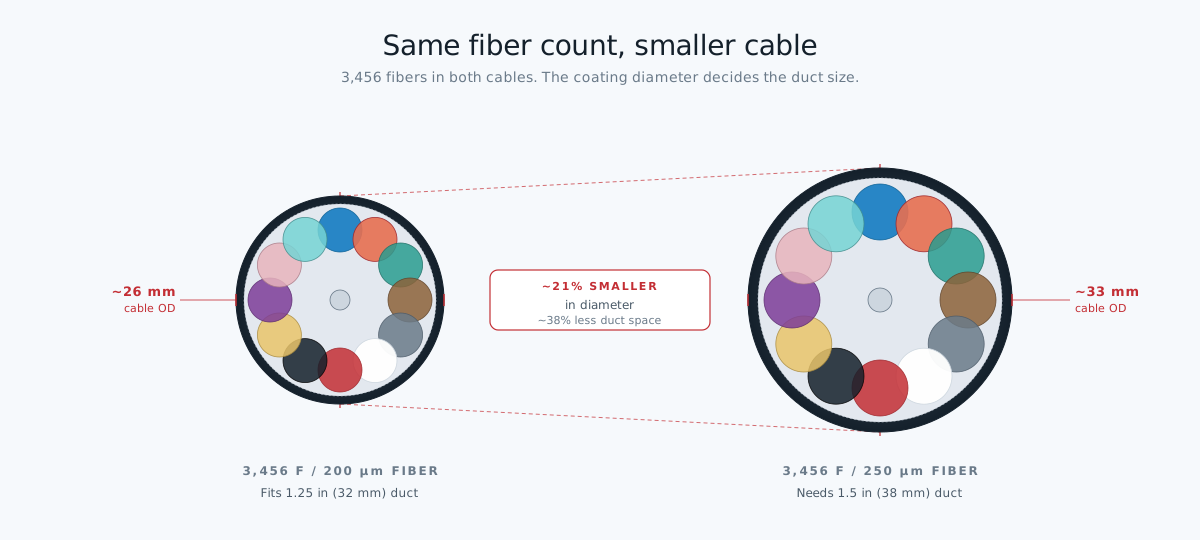
This is the first in a short series on splicing fiber that isn't standard 250µm. The next pieces will cover splicing 200µm to 250µm in detail and hollow core fiber splicing once that's worth a guide on its own.
What's actually different
Almost nothing on the glass, almost everything on the handling.
The glass fiber inside a 200µm cable is the same 125µm cladding diameter you've been splicing for years. Same core, same single-mode performance, same everything optically. What's different is the buffer coating around the glass. 250µm fiber has a 250µm outer diameter on the coating. 200µm fiber is 200µm. That's it. The light doesn't care.
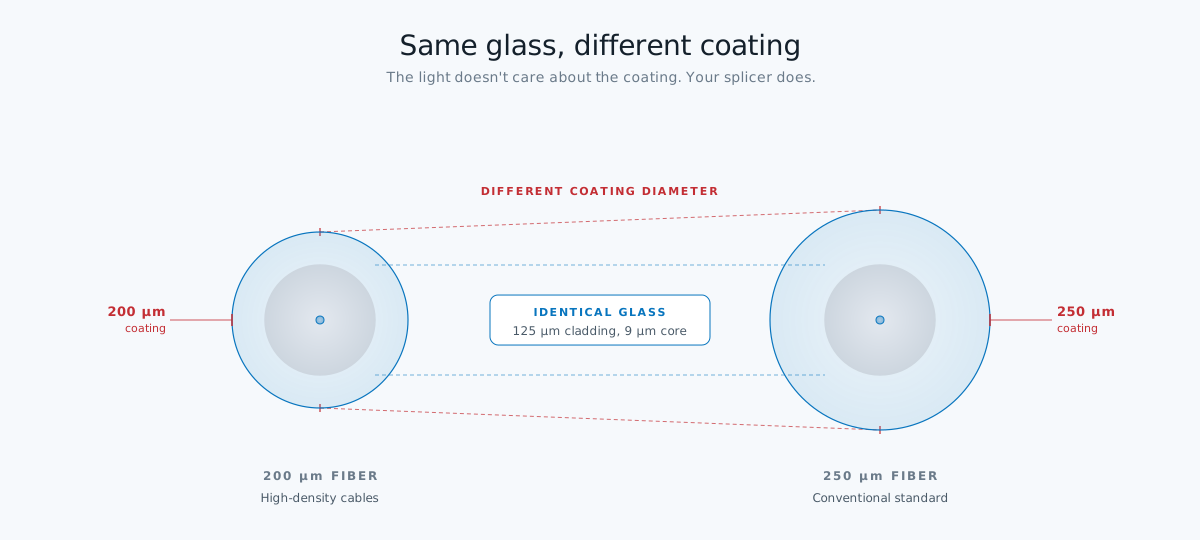
What changes is everything that touches the fiber: the V-groove that holds it during alignment, the fiber holder that clamps it, and the ribbon spacing if you're working with ribbon. All of that has to match the smaller coating diameter or your splices won't seat properly.
What equipment you need
The good news is you probably already have most of it, if your splicer is recent enough. The bad news is 200µm support is a generational divide. Splicers built before about 2018 generally have fixed V-grooves designed for 250µm and can't easily be adapted. The current generation introduced replaceable V-grooves specifically because the industry was moving to 200µm. If you're working primarily on 200µm jobs, the splicer matters as much as the accessories.
Splicer. A current-generation mass fusion splicer like the Fujikura 90R or 100R, the Sumitomo Q102-M12+, or the Inno View 12R-200 handles both 200µm and 250µm with the right accessories. Older splicers (Fujikura 70R/70S, Sumitomo Q101 series) have fixed V-grooves and aren't the right tool for this work.
V-grooves. This is where most techs trip the first time. The V-groove is the precision groove that holds each fiber during arc alignment. It's sized for the coating diameter. Put a 200µm fiber in a 250µm V-groove and the fiber sits too low, alignment goes off, splice loss climbs. You need a V-groove specifically machined for 200µm. They're field-replaceable on current splicers, so you swap them yourself on the truck in a few minutes. Order spares with the unit and keep them in the case.
Fiber holders. Same logic. The fiber holder clamps the ribbon or singles in place. A standard 250µm holder doesn't grip 200µm fiber correctly. You need a holder rated for 200µm.
Pitch conversion holder. This is the special one. More on this below.
The table at the end of this guide lists current and older splicers with their specific 200µm accessory requirements.
What pitch correction is
This is the concept most techs haven't run into before. Pitch is the spacing between fibers in a ribbon. A 250µm pitch ribbon has fibers spaced 250µm apart, center to center. A 200µm pitch ribbon has fibers spaced 200µm apart. Tighter packing, more fibers per cable.
Here's the problem. Your splicer's V-groove block has fixed spacing. A standard 12-fiber V-groove for 250µm fiber has slots machined at 250µm intervals. Drop a 200µm pitch ribbon onto that block and the fibers don't land in the slots.
Pitch correction is a mechanical adapter that takes a 200µm pitch ribbon and physically spaces the fibers out to 250µm so they fit in a standard V-groove. Fujikura calls it the FH-70-12PC pitch conversion holder. You load your 200µm pitch ribbon into the holder, it routes each fiber through guides that spread them to 250µm spacing, and now they sit correctly in a standard V-groove for splicing.
This is also how you splice 200µm pitch to 250µm pitch on the same splicer in the same operation: the pitch conversion holder normalizes both sides to 250µm.
The alternative on a splicer that supports it directly is to swap in a dedicated 200µm V-groove and skip the pitch conversion step. Faster if you're doing all 200µm work. Less convenient if you're switching between formats.
Can you splice 200µm to 250µm
Yes. Single-fiber splicing of 200µm to 250µm is straightforward because the glass is identical. Strip, cleave, splice. Your splicer doesn't know or care that the coating diameter changed.
Ribbon splicing of 200µm to 250µm is where pitch correction earns its keep. Handle the pitch difference with the conversion holder, the splicer treats both sides as 250µm-spaced, and the splice itself is the same arc you've been firing for years.
What about testing
Nothing changes. OTDR, OLTS, all of it works the same way on 200µm fiber as it does on 250µm. The glass is the same, the core is the same, the optical characteristics are the same. Coating diameter doesn't affect light propagation.
Equipment by splicer
| Splicer | Generation | 200µm to 200µm | 200µm to 250µm |
|---|---|---|---|
| Fujikura 90R / 100R | Current | VG12-01-200 V-groove (or VG16-01-200 for 16-fiber), FH-70-12 holder (handles both 200µm and 250µm SWR) | FH-70-12PC pitch conversion holder converts 200µm pitch to 250µm spacing; use with standard VG12-01 V-groove |
| AFL (branded Fujikura) | Current | See Fujikura 90R / 100R row. AFL distributes Fujikura splicers in North America under their own SKUs; the underlying hardware and accessory part numbers match. | See Fujikura 90R / 100R row |
| Sumitomo Q102-M12+ / Q102-CA+ | Current | 200µm V-groove kit (tool-free swap), FHM-12V 12-fiber holders | Swap V-groove block to 250µm pitch; use Sumitomo's pitch conversion accessories for mixed ribbons |
| Sumitomo Quantum-ULTRA (16f-200) | Current | Purpose-built for 16-fiber 200µm pitch out of the box | Less flexible for 250µm; not the right splicer if you switch formats often |
| Inno View 12R-200 | Current | 200µm ribbon V-groove built in, no accessory swap needed | Requires pitch conversion accessory or separate fiber preparation; confirm with vendor for current part numbers |
| Inno View 12X / 12R Pro | Current | Supports 200µm with appropriate V-groove configuration | Pitch conversion accessory needed; Inno's English documentation is less detailed than Fujikura's or Sumitomo's, so call your distributor for current part numbers |
| Fujikura 70R / 70R+ | Older | Fixed V-groove designed for 250µm. Limited or no native 200µm support. Upgrade to 90R is the supported path. | Not recommended. Possible with workarounds but splice quality and consistency suffer. |
| Fujikura 70S / 70S+ | Older | Single-fiber/ribbon splicer with fixed V-groove. Designed for 250µm. No native 200µm support. | Not recommended for production work in mixed environments. |
| Sumitomo Q101 series (Q101-M12, Q101-CA, Q101-VS) | Older | Fixed V-groove, designed for 250µm. The Q102 series replaced the Q101 specifically to add tool-swappable V-grooves for 200µm. | Not recommended. The Q102+ upgrade is the supported path. |
| Inno legacy models (View 6, older View series) | Older | Generally 250µm only. Limited 200µm support, if any. | Not recommended. |
Next in the series
The next piece will dig into splicing 200µm to 250µm in mixed environments, because that's where most techs are actually working: 200µm in the new high-count trunk, 250µm in the legacy lateral or the customer drop.