
You've probably heard the term by now. Microsoft is putting it in the ground, Corning is starting to make it at scale, and every fiber industry headline lately mentions it. But most working techs I talk to know it's "the new thing" without knowing what it actually is or where they'll run into it.
This is the first piece in a series I'm putting together on hollow core fiber — the basics first, then later: installation, splicing, and testing. For now, just what it is and what it's for.
What it is
Hollow core fiber is fiber where the light travels through air instead of glass.
Standard single-mode fiber — the stuff you've been splicing for years — has a solid glass core. Light propagates through that glass, bouncing around inside it the whole way. Hollow core fiber replaces that solid core with a hollow channel. The light travels through air. The cladding around it uses a microstructured pattern of tiny glass tubes to keep the light confined in the center.
That's the whole idea. Different medium for the light. Air instead of glass.
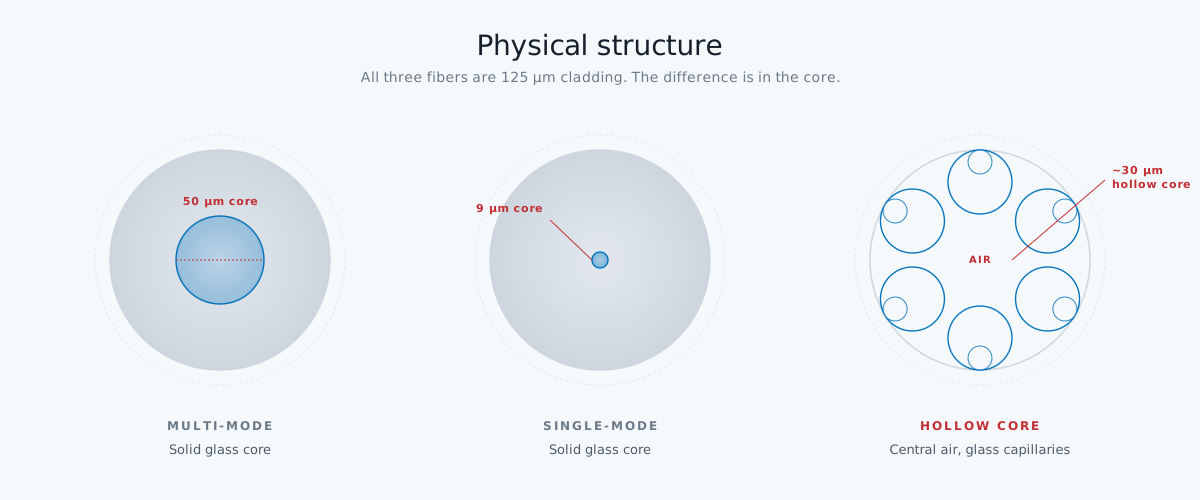
It sounds like a small change. It isn't.
What's different about it
Three things matter operationally.
Light travels faster in air. About 47% faster than in glass. That's the headline number you'll see in every press release, and it's not marketing fluff. The physics is real. For applications where every microsecond of latency costs money, that 47% is a big deal.
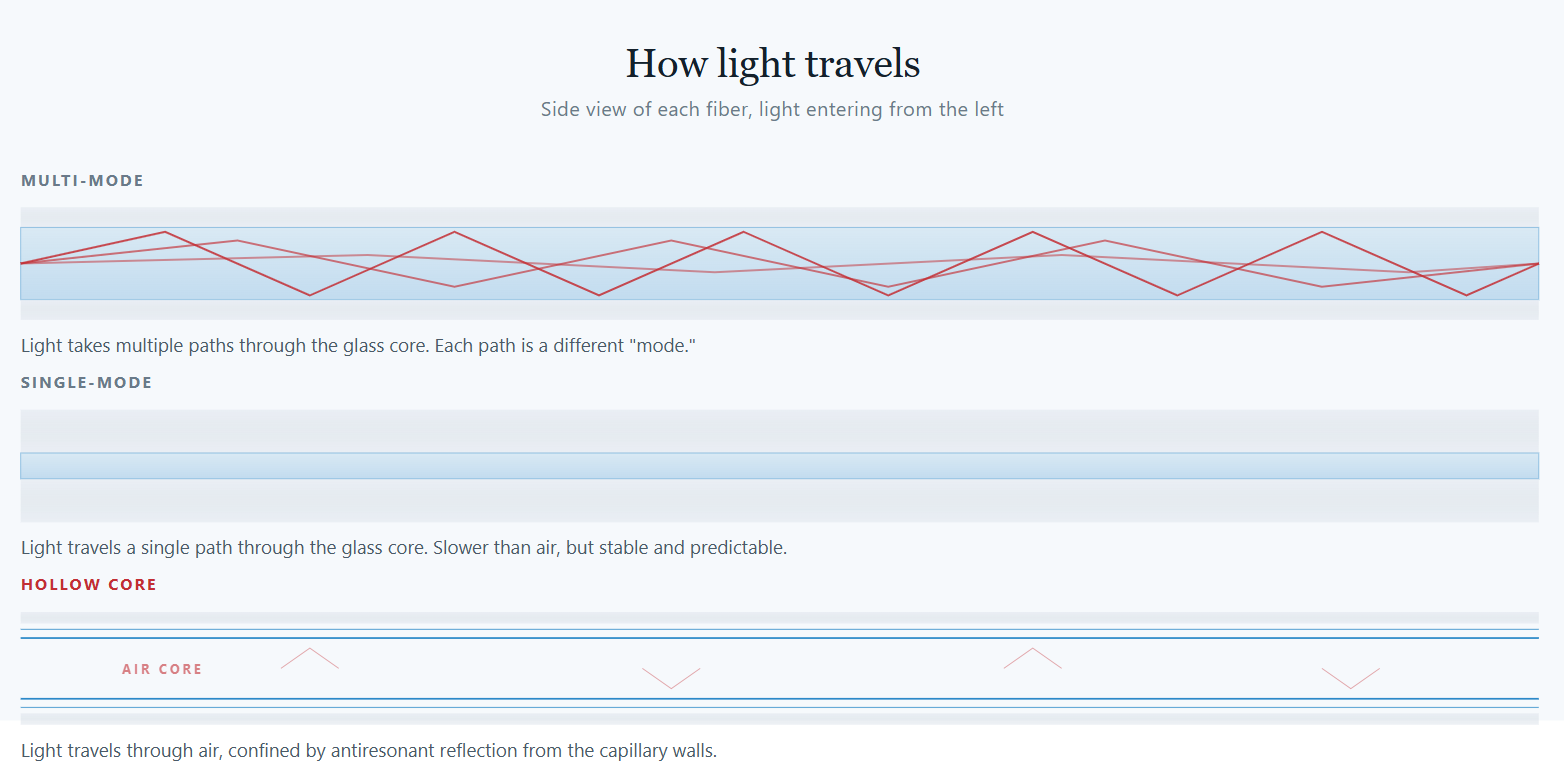
Lower nonlinearity. Solid glass interacts with the light passing through it. At high power or long distances, that interaction shows up as distortion. Air doesn't have those interactions. So hollow core fiber can run higher power, carry more bandwidth, and stretch further between repeaters.
Different loss profile. Early hollow core fiber had terrible loss numbers — around 2.5 dB/km when Microsoft picked up Lumenisity in 2022. Worse than your worst SMF run. By early 2026, Microsoft is reporting 0.091 dB/km across 1,200 km of production fiber. That's lower than standard single-mode glass fiber. The industry crossed a real threshold in the last 18 months.
The trade-off is that everything else is harder. Splicing it. Connecting it. Testing it. The hollow core means you're trying to preserve a tiny air channel across every joint, and standard procedures don't apply. More on that in later posts.
Where it's actually being deployed
This is the part that's changed fast in the last two years. Hollow core has moved from lab curiosity to production deployments, and as of early 2026, both of the two largest cloud hyperscalers are now using it.
Microsoft Azure. The biggest deployment by volume. Over 1,280 km of live hollow core fiber across Azure regions by early 2026, with plans to hit 15,000 km. They're using it for data center interconnect, especially routes that have to carry AI workloads where latency matters. Microsoft acquired Lumenisity in 2022, bought their UK fab, and is now partnered with Corning and Heraeus Covantics to scale production in the US and Europe.
AWS. Amazon's cloud arm is now deploying hollow core fiber too. In a February 2026 interview with Data Center Knowledge, AWS Network Engineering VP Matt Rehder described the technology as "still a nascent technology" but said AWS is already running it in production at five to ten locations. The use case is different from Microsoft's. AWS availability zones are made up of multiple physical data centers that have to behave like a single facility, which requires keeping latency between them under about half a millisecond. That latency budget limits how far apart those data centers can physically sit. Hollow core widens that radius. It lets AWS build availability zones across longer distances where land or power isn't available close enough together to do it with conventional fiber. Rehder noted hollow core is still significantly more expensive than standard fiber, but said the trade-off is worth it when it enables expansion AWS couldn't do otherwise.
Financial services. Trading firms have been the early customer for any fiber tech that cuts latency. A few hundred microseconds saved on a long route between trading venues is worth real money to them. They've been quiet about specifics, but they're using it.
Telco trials. BT started trialing hollow core in 2021 for mobile backhaul. Comcast tested it over a 40 km link, hitting 10 to 400 Gbps and confirming backward compatibility with their existing systems. euNetworks has deployed Lumenisity CoreSmart cable in London. Most of these are pilots and limited routes, not full network builds.
Hyperscaler AI interconnect. The demand curve is bending here. The data centers running large AI training workloads need extreme bandwidth between sites, and they need it now. Hollow core's combination of low latency and high capacity fits that need better than anything else available. Both Microsoft and AWS are pointing at AI workloads as a primary driver of their hollow core investment.
What you're not seeing yet is hollow core in the access network, in long-haul backbone, or in any general-purpose deployment. It's still too expensive and too specialized for that. Industry analysts expect general metro and regional deployment somewhere in the 2029–2031 range, with broad rollout not before the mid-2030s.
So if you're a working field tech, you probably won't see it on your typical splice job yet. But if you're in a market with hyperscaler data centers, financial trading infrastructure, or major carrier backbone routes, you might be running into it sooner than you think.
No standard yet
Conventional fiber is governed by the ITU-T G.65x family. G.652 single-mode, G.657 bend-insensitive, and so on. Every G.652 fiber meets the same spec regardless of who made it. That's what makes the global fiber industry work.
Hollow core doesn't have an equivalent yet. ITU-T and IEC haven't published a standard that defines what an HCF formally is or what parameters it has to meet. Each manufacturer's design is proprietary. Microsoft's DNANF and Relativity Networks' HCF aren't the same product. They don't splice interchangeably and they require different testing approaches. Formal standards will come eventually as the technology matures. For now, HCF is a category of proprietary designs that share a name and a physical principle, not a unified specification.

What this means for you
Hollow core fiber isn't replacing the glass you've been splicing for the last 20 years. Not anytime soon. The cost, the manufacturing scale, the trained labor force — none of it is there yet for general deployment.
But it's also not science fiction anymore. It's in the ground, carrying real traffic, in real production networks. The techs who'll be working on it five years from now are the ones learning what it is and how it's different now.
This series is going to cover the rest of it. Installation considerations. Splicing techniques and the connectors that are being used. How OTDR and OLTS testing change when the light isn't traveling through glass. Each piece will be its own guide as I work through the material.